AI 编程的11月革命
去年11月发布的 Claude Opus 4.5 和 Codex 5.2 标志着AI编程领域的拐点,可用性显著提升,编程从此由“AI辅助人”跨越为“人辅助AI”。越来越多的人开始意识到这个量变到质变的节点,The November Moment。手工编程即将迎来尾声,未来将是自动编程时代,而智能体也自此真正走向前台。
这场由手动编程到自动编程的变革,其意义远不止于AI取代人。当人类从基础编码工作中解放,编程的职业技能将迎来重构。而随着“人”这个瓶颈被移除,软件的组织与构建形式,以及编程语言本身,也都将以“AI”的能力边界为核心重塑。
Andrej Karpathy @ X.com 2025-12-27
I’ve never felt this much behind as a programmer. The profession is being dramatically refactored as the bits contributed by the programmer are increasingly sparse and between.
I have a sense that I could be 10X more powerful if I just properly string together what has become available over the last ~year and a failure to claim the boost feels decidedly like skill issue.
There’s a new programmable layer of abstraction to master (in addition to the usual layers below) involving agents, subagents, their prompts, contexts, memory, modes, permissions, tools, plugins, skills, hooks, MCP, LSP, slash commands, workflows, IDE integrations, and a need to build an all-encompassing mental model for strengths and pitfalls of fundamentally stochastic, fallible, unintelligible and changing entities suddenly intermingled with what used to be good old fashioned engineering.
Clearly some powerful alien tool was handed around except it comes with no manual and everyone has to figure out how to hold it and operate it, while the resulting magnitude 9 earthquake is rocking the profession. Roll up your sleeves to not fall behind.
Thomas Wolf @ X.com 2026-02-16
- Monoliths return – cheap rewriting kills dependency trees; smaller attack surface, better performance, bare-metal becomes realistic
- Lindy effect weakens – legacy code loses its moat, but unknown unknowns persist; formal verification becomes essential
- Strongly typed languages rise – human psychology mattered for adoption; now formal verification and RL environments favor types over ergonomics
- Open source restructures – human connection drove the community; AI-written/read code breaks those incentives; alignment becomes decisive
- New languages diverge – AI may not share our tradeoffs; optimal LLM programming languages may look nothing like what humans converged on
Andrej Karpathy @ X.com 2026-02-17
I think it must be a very interesting time to be in programming languages and formal methods because LLMs change the whole constraints landscape of software completely.
Hints of this can already be seen, e.g. in the rising momentum behind porting C to Rust or the growing interest in upgrading legacy code bases in COBOL or etc. In particular, LLMs are especially good at translation compared to de-novo generation because 1) the original code base acts as a kind of highly detailed prompt, and 2) as a reference to write concrete tests with respect to.
That said, even Rust is nowhere near optimal for LLMs as a target language. What kind of language is optimal? What concessions (if any) are still carved out for humans? Incredibly interesting new questions and opportunities. It feels likely that we’ll end up re-writing large fractions of all software ever written many times over.
Boris Cherny @ X.com 2025-12-27
Sometimes I start approaching a problem manually, and have to remind myself “claude can probably do this”.
Recently we were debugging a memory leak in Claude Code, and I started approaching it the old fashioned way: connecting a profiler, using the app, pausing the profiler, manually looking through heap allocations.
My coworker was looking at the same issue, and just asked Claude to make a heap dump, then read the dump to look for retained objects that probably shouldn’t be there; Claude 1-shotted it and put up a PR. The same thing happens most weeks.In a way, newer coworkers and even new grads that don’t make all sorts of assumptions about what the model can and can’t do — legacy memories formed when using old models — are able to use the model most effectively.
It takes significant mental work to re-adjust to what the model can do every month or two, as models continue to become better and better at coding and engineering.The last month was my first month as an engineer that I didn’t open an IDE at all. Opus 4.5 wrote around 200 PRs, every single line.
Software engineering is radically changing, and the hardest part even for early adopters and practitioners like us is to continue to re-adjust our expectations. And this is still just the beginning.
The November Moment - Simon Willison 2026-01-04
It genuinely feels to me like GPT-5.2 and Opus 4.5 in November represent an inflection point - one of those moments where the models get incrementally better in a way that tips across an invisible capability line where suddenly a whole bunch of much harder coding problems open up.
Opus 4.5 is going to change everything - Burke Holland 2026-01-05
Opus 4.5 is not normal. And by “normal”, I mean that it is not the normal AI agent experience that I have had thus far.
So far, AI Agents seem to be pretty good at writing spaghetti code and after 9 rounds of copy / paste errors into the terminal and “fix it” have probably destroyed my codebase to the extent that I’ll be throwing this whole chat session out and there goes 30 minutes I’m never getting back.
Opus 4.5 feels to me like the model that we were promised - or rather the promise of AI for coding actually delivered.
Aditya Agarwal @ X.com 2026-02-03
It’s a weird time. I am filled with wonder and also a profound sadness.
I spent a lot of time over the weekend writing code with Claude. And it was very clear that we will never ever write code by hand again. It doesn’t make any sense to do so. Something I was very good at is now free and abundant. I am happy…but disoriented.
At the same time, something I spent my early career building (social networks) was being created by lobster-agents. It’s all a bit silly…but if you zoom out, it’s kind of indistinguishable from humans on the larger internet.
So both the form and function of my early career are now produced by AI.
I am happy but also sad and confused.
The A.I. Disruption We’ve Been Waiting for Has Arrived - Paul Ford 2026-02-18
[Claude Code] was always a helpful coding assistant, but in November it suddenly got much better, and ever since I’ve been knocking off side projects that had sat in folders for a decade or longer. It’s fun to see old ideas come to life, so I keep a steady flow. Maybe it adds up to a half-hour a day of my time, and an hour of Claude’s.
November was, for me and many others in tech, a great surprise. Before, A.I. coding tools were often useful, but halting and clumsy. Now, the bot can run for a full hour and make whole, designed websites and apps that may be flawed, but credible. I spent an entire session of therapy talking about it.
When you watch a large language model slice through some horrible, expensive problem — like migrating data from an old platform to a modern one — you feel the earth shifting.
Andrej Karpathy @ X.com 2026-02-26
It is hard to communicate how much programming has changed due to AI in the last 2 months: not gradually and over time in the “progress as usual” way, but specifically this last December.
There are a number of asterisks but imo coding agents basically didn’t work before December and basically work since - the models have significantly higher quality, long-term coherence and tenacity and they can power through large and long tasks, well past enough that it is extremely disruptive to the default programming workflow.
As a result, programming is becoming unrecognizable. You’re not typing computer code into an editor like the way things were since computers were invented, that era is over. You’re spinning up AI agents, giving them tasks in English and managing and reviewing their work in parallel. The biggest prize is in figuring out how you can keep ascending the layers of abstraction to set up long-running orchestrator Claws with all of the right tools, memory and instructions that productively manage multiple parallel Code instances for you. The leverage achievable via top tier “agentic engineering” feels very high right now.
An AI agent coding skeptic tries AI agent coding - Max Woolf 2026-02-27
The real annoying thing about Opus 4.6/Codex 5.3 is that it’s impossible to publicly say “Opus 4.5 (and the models that came after it) are an order of magnitude better than coding LLMs released just months before it” without sounding like an AI hype booster clickbaiting, but it’s the counterintuitive truth to my personal frustration. I have been trying to break this damn model by giving it complex tasks that would take me months to do by myself despite my coding pedigree but Opus and Codex keep doing them correctly.
Andrej Karpathy @ X.com 2026-02-28
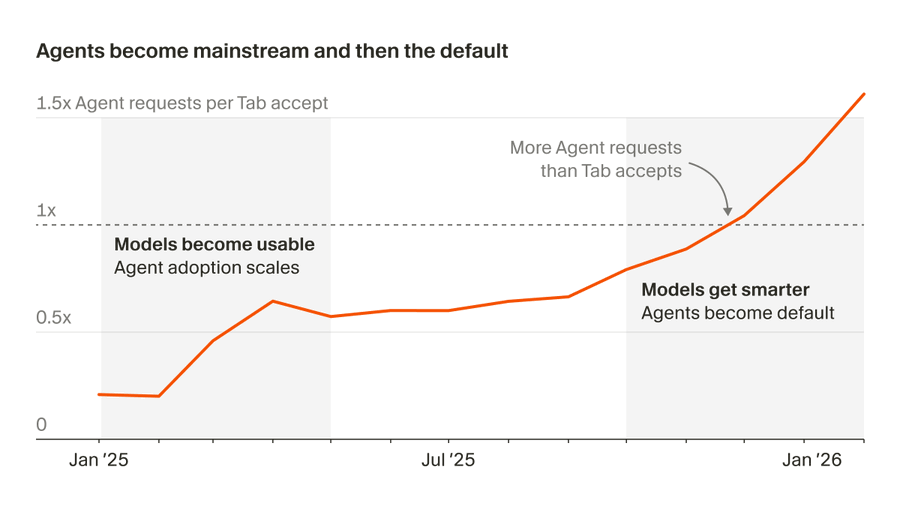
Cool chart showing the ratio of Tab complete requests to Agent requests in Cursor.
With improving capability, every point in time has an optimal setup that keeps changing and evolving and the community average tracks the point. None -> Tab -> Agent -> Parallel agents -> Agent Teams (?) -> ???
If you’re too conservative, you’re leaving leverage on the table. If you’re too aggressive, you’re net creating more chaos than doing useful work.
The art of the process is spending 80% of the time getting work done in the setup you’re comfortable with and that actually works, and 20% exploration of what might be the next step up even if it doesn’t work yet.